
What Are Chakras? A Grounded Guide to the 7 Chakras and Energy Balance
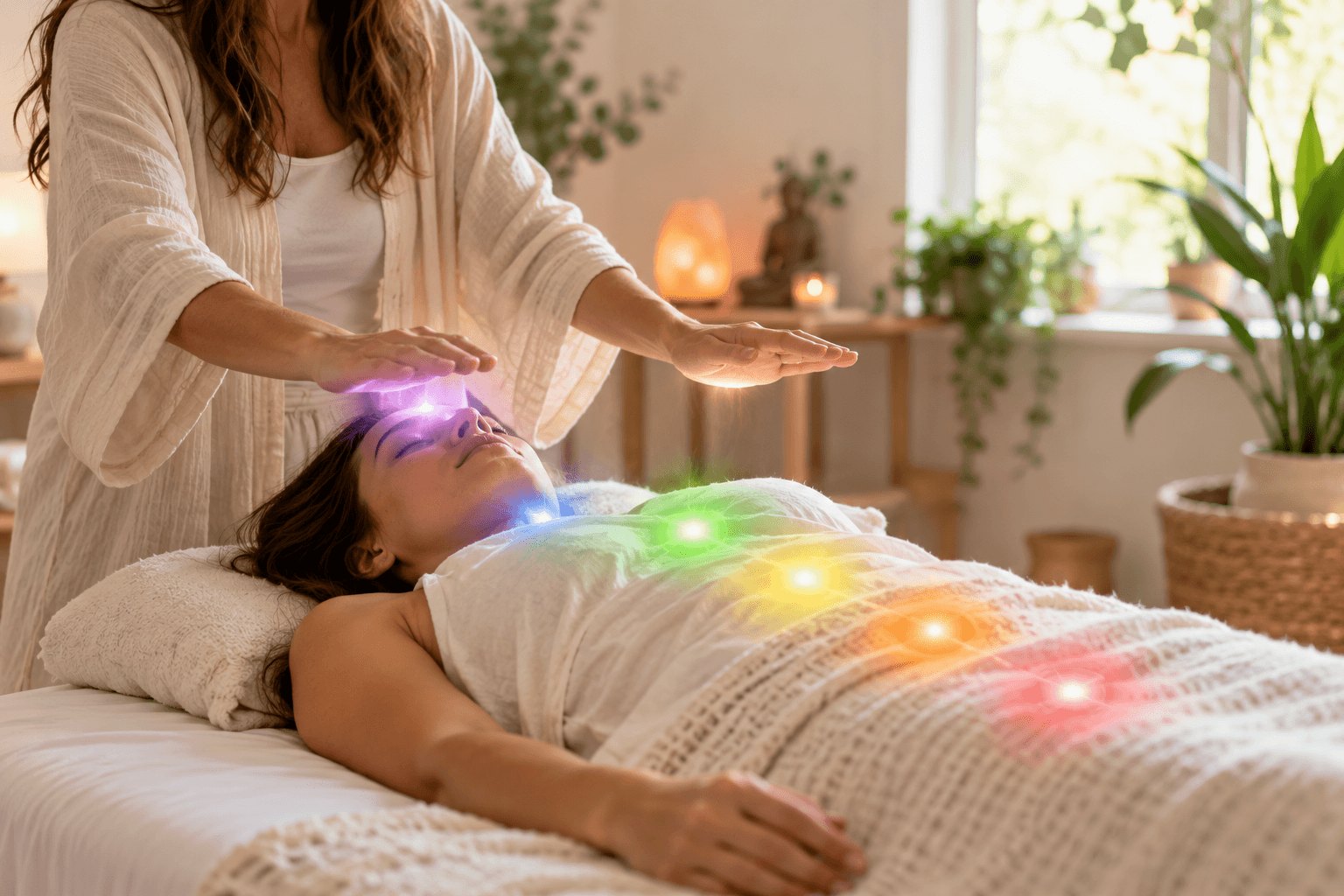
If you’ve taken a yoga class, experienced Reiki or sound healing, or spent any time exploring holistic wellness, you’ve probably heard someone talk about chakras.
Maybe you’ve heard phrases like “open your heart chakra,” “ground your root chakra,” or “balance your energy.” But what are chakras, exactly? Chakras are traditionally understood as wheel-like, spinning subtle-energy centers in the human body—part of ancient South Asian spiritual traditions rather than physical structures you could see on an X-ray or blood test.
The concept of chakras comes from ancient South Asian spiritual traditions. The word chakra comes from Sanskrit and is commonly translated as “wheel” or “circle.” In these traditions, chakras are aligned along the vertical axis of the body and described as energetic centers that connect physical experience, emotions, relationships, intuition, and spiritual well-being (source).
Today, the 7 chakras are commonly used as a framework for thinking about energy balance. The seven main chakras are typically mapped along the spine up to the crown of the head and are commonly understood to influence both physical and emotional health, alongside our sense of safety, relationships, intuition, and spiritual connection.
In my work, I find that you don’t have to understand every aspect of energy healing—or even have previous experience with it—to become more curious about what your body may be communicating. Whether you’re new to chakras or already exploring yoga, Reiki, sound healing, or somatic practices, this framework can support self-awareness and offer a useful way to notice patterns in your physical, emotional, and spiritual experience alongside conventional health care.
Let’s walk through what the 7 chakras are, the 7 chakra names and colors, where they are located, what chakra colors symbolize, how to balance chakras, and how chakras relate to practices like Reiki, sound healing, and even the nervous system.
What Are Chakras?
Chakras are described in several Hindu and Buddhist traditions as centers of subtle energy within the body. Different traditions describe different numbers and arrangements of chakras, but the 7 chakras of the body have become the system most familiar in modern Western wellness practices. The word chakra translates from Sanskrit as “wheel” or “disk,” and these centers are often called chakras in teachings about subtle anatomy.
Rather than thinking about chakras as physical organs, it may be more helpful to think of them as an energetic framework within the energetic body and a broader energy system. In that sense, chakras act as a model for understanding how different parts of life relate to well-being.
Each of the 7 chakras in the body is traditionally associated with a particular area of the body and different aspects of our emotional, mental, and spiritual experience. In yogic philosophy, life energy moves through subtle energy channels, traditionally called nadis, which intersect at these centers.
When people talk about energy balance, they are generally describing a sense that energy is moving freely rather than feeling stagnant, depleted, or overwhelmed. When a chakra is open and balanced, it is said to support freer energy flow through the nadis, which is associated with holistic health.
Chakras are not recognized as anatomical structures in Western medicine, and chakra work should not be considered a substitute for medical or mental health care. For many people, however, this framework provides another way to pay attention to their bodies, emotions, and internal experiences.
RELATED READING: Curious about energy work? Read What Is Reiki? A Beginner’s Guide to Reiki Energy Healing to learn how Reiki approaches energetic balance and relaxation.
What Are the 7 Chakras?
If you're searching for a simple 7 chakras definition, the seven chakras system describes the main chakras as seven primary energy centers located along the spine from the base to the crown.
Each is traditionally connected with particular qualities or themes.
Here is a simple 7 chakras chart you can refer back to:
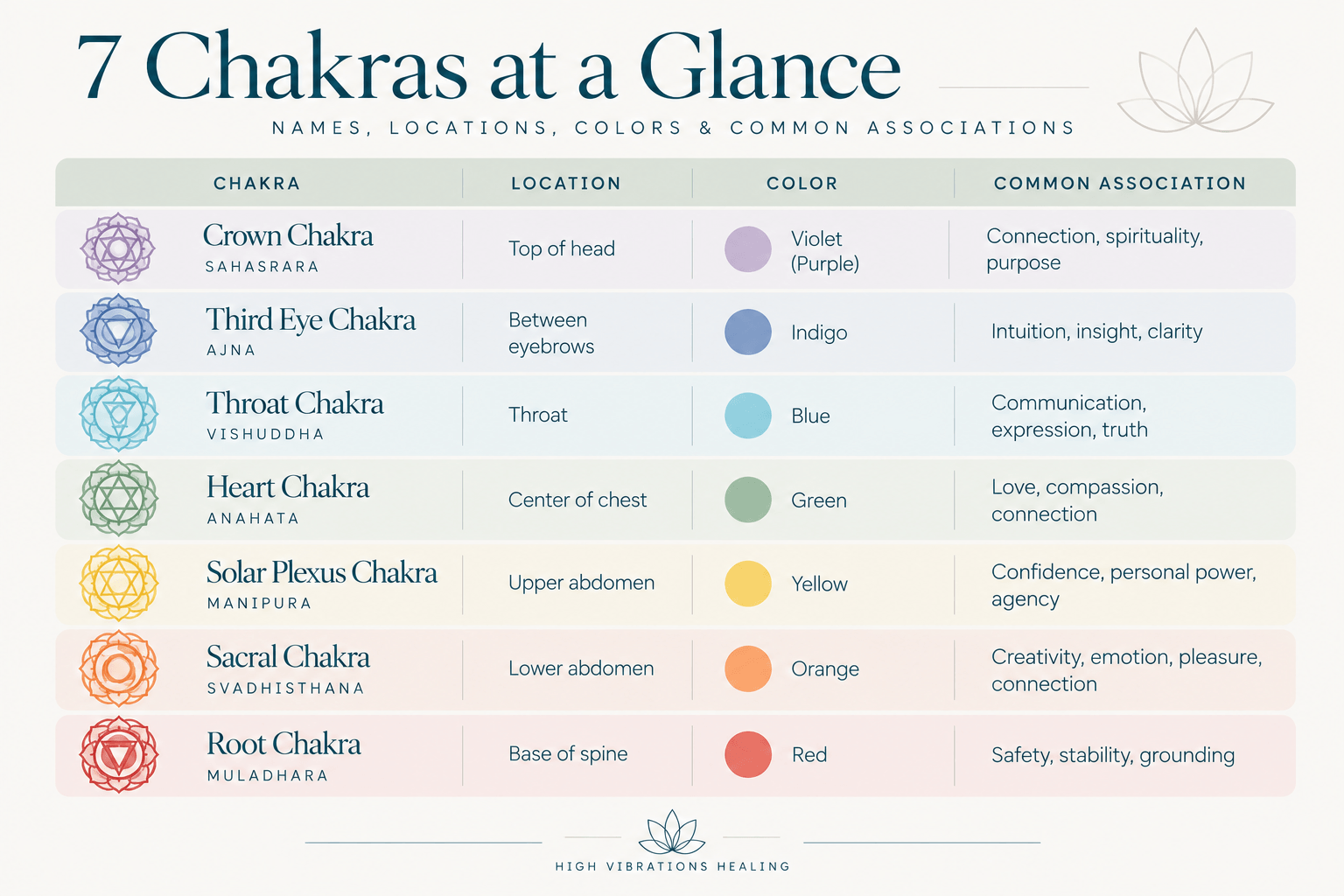
Table of the 7 chakras in the body
Each of these centers is also commonly associated with a specific color and element, though details may vary by tradition.
You may see slightly different descriptions depending on the tradition or practitioner. Chakra work is an energetic and spiritual framework, so there isn't one standardized clinical definition for each energy center.
The 7 Chakras: Names, Colors, and Meanings
Let’s take a closer look at each 7 chakra description and what it traditionally represents.
1. Root Chakra: Muladhara
Location: Base of the spine
Color: Red
Associated with: Safety, security, stability, and grounding
The root chakra forms the foundation of the seven-chakra system. It is associated with our basic sense of safety, belonging, and stability.
When someone feels grounded, there may be a sense of being present and connected to their body. During prolonged periods of stress or uncertainty, that sense of stability can become harder to access.
This is one area where I often see an interesting overlap between energetic practices and somatic work: both invite us to notice what it actually feels like to be present and safe within the body.
EXPLORE SOMATIC WELLNESS: Learn more about Somatic Wellness at High Vibrations Healing and the body-centered techniques I use to support greater awareness, grounding, and regulation.
2. Sacral Chakra: Svadhisthana
Location: Lower abdomen
Color: Orange
Associated with: Creativity, emotions, pleasure, and connection
The sacral chakra is traditionally associated with our emotional world, creativity, relationships, and ability to experience pleasure. Also known as the second chakra, it is orange, located below the navel, and linked to creative energy and emotional energy.
When exploring this chakra, especially through themes of a balanced sacral chakra like adaptability, pleasure, and emotional balance, you might become curious about questions like:
Do I allow myself to experience joy? Do I feel connected to my emotions? Where am I holding back creatively or emotionally?
Chakra work doesn't require finding a “wrong” answer. Sometimes simply noticing what comes up can create greater self-awareness.
3. Solar Plexus Chakra: Manipura
Location: Upper abdomen
Color: Yellow
Associated with: Confidence, agency, self-esteem, and personal power
The solar plexus chakra relates to how we experience ourselves in the world, and solar plexus chakra energy is traditionally tied to will, digestion, and how we act on our sense of personal power.
It is often connected with confidence, boundaries, decision-making, and the ability to act from a sense of personal agency.
For someone who has spent years caring for others, responding to stress, or putting their own needs last, reconnecting with this part of themselves can feel particularly meaningful.
4. Heart Chakra: Anahata
Location: Center of the chest
Color: Green
Associated with: Love, compassion, connection, and acceptance
The heart chakra sits in the middle of the seven-chakra system and is traditionally associated with our capacity to give and receive love. As the fourth chakra, it is also linked with the heart chakra symbol, love and compassion, and the heart and lungs.
This isn't limited to romantic love. A balanced heart chakra is often associated with compassion, openness, positive emotions, and emotional healing, while blockage may show up as anger or jealousy. It can include compassion, grief, forgiveness, connection, and our relationship with ourselves.
For people who have experienced loss, relational trauma, or prolonged stress, exploring this area can sometimes bring up complex emotions. That is one reason I believe energy work should always be approached gently and without forcing an emotional response.
Some practitioners also use Half Bridge Pose (Ardha Setubandhasana) to support this energy center.
5. Throat Chakra: Vishuddha
Location: Throat
Color: Blue
Associated with: Communication, expression, and truth
The throat chakra is associated with our ability to communicate authentically, and the fifth chakra is also often linked symbolically to the thyroid gland. Practitioners may also use the throat chakra symbol in meditation or visualization to support clear expression.
That can mean speaking up, setting boundaries, asking for what we need, or feeling comfortable expressing emotions and ideas.
It can also invite us to notice the opposite: the times we silence ourselves, struggle to communicate, or feel that our voice isn't being heard.
Some chakra-based yoga approaches use Shoulderstand (Sarvangasana) to support throat chakra balance.
6. Third Eye Chakra: Ajna
Location: Between the eyebrows
Color: Indigo
Associated with: Intuition, awareness, insight, and clarity
The third eye chakra is often what people picture when they hear about intuition or inner knowing. In some teachings, this center is also described as the third chakra for perception and insight, linking it to inner wisdom and spiritual awareness.
It represents our ability to look beyond immediate reactions and connect with a broader sense of awareness. Some practitioners also connect Ajna with the pituitary gland and use the third eye chakra symbol or eye chakra symbol in visualization practices.
Working with this chakra doesn't have to mean having a mystical experience. It can simply involve slowing down enough to notice what you're feeling, what you're sensing, and what your own internal wisdom may be telling you. A balanced third eye chakra is often associated with clarity, while imbalance may show up as confusion or physical symptoms such as headaches. Some practitioners use Headstand (Shirshasana) in chakra-oriented yoga to stimulate Ajna.
7. Crown Chakra: Sahasrara
Location: Top of the head
Color: Violet or purple
Associated with: Spirituality, connection, purpose, and meaning
The crown chakra is the highest of the 7 chakras in the body, often described as the highest chakra and associated with universal energy, divine consciousness, and connection beyond ourselves.
Depending on your personal beliefs, that might mean spirituality, faith, purpose, consciousness, or simply feeling connected to something larger than your immediate circumstances. A balanced crown chakra is often described as bringing clarity and peace, and some chakra traditions also link it with the pineal gland. Some practitioners also use the crown chakra symbol in meditation or visualization.
Like all chakra work, what this means can look different from person to person.
What Are Chakra Colors?
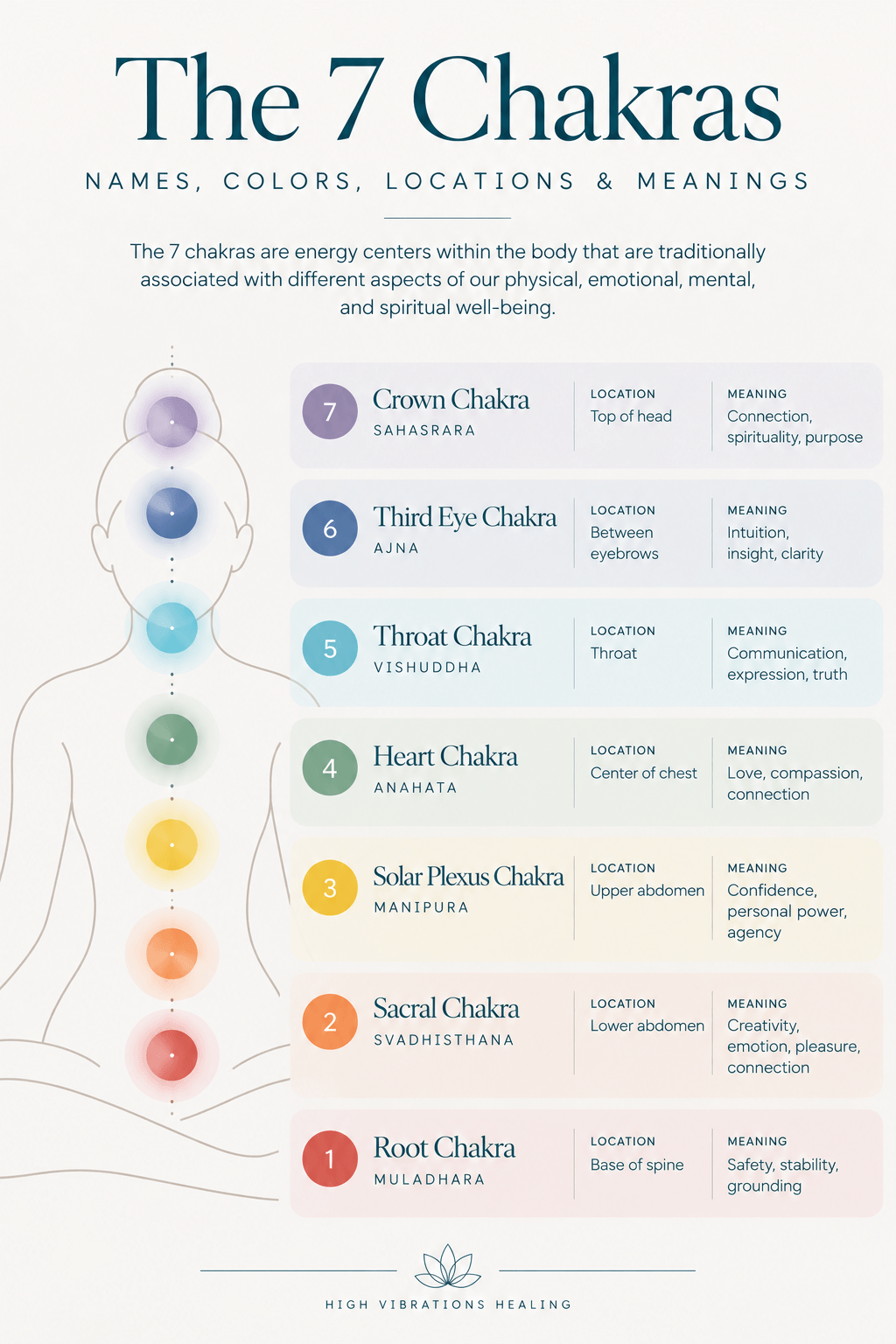
One of the most recognizable features of a modern 7 chakras chart is the rainbow progression from red at the root chakra to violet at the crown.
So, what are chakra colors supposed to mean?
In modern chakra practices, colors are used as symbols to help distinguish and visualize each energy center, and some practitioners use color-based visualization or chakra color therapy to support balance in a corresponding chakra. You may see them incorporated into meditation, crystals, artwork, sound healing, or other energy practices.
It's worth knowing that the familiar rainbow system wasn't part of the earliest chakra teachings. The specific color associations commonly used today developed later as chakra concepts evolved and became incorporated into Western wellness traditions.
Some systems also connect chakra colors and elements with supportive choices such as diet, though approaches vary.
I think that distinction is important. We can appreciate and use modern chakra practices while still respecting where these ideas originated and acknowledging how they've changed over time.
What Does It Mean to Balance Your Chakras?
You may hear people describe a chakra as “blocked,” “open,” or “out of balance.”
These aren't medical diagnoses.
From an energetic perspective, these terms are ways of describing how someone may be experiencing themselves physically, emotionally, or spiritually. People also sometimes use chakra language as a psychological map for personal growth, including patterns that affect physical emotional and spiritual well-being, emotional states, and broader life themes.
For example, someone exploring their root chakra might notice that they have difficulty feeling grounded. Someone focusing on the throat chakra may be examining patterns around communication or self-expression. In this framework, blocked chakras may show up as chronic tension in certain body areas, emotional reactions that feel bigger than the trigger, or other physical symptoms.
The goal isn't necessarily to achieve seven perfectly “balanced” chakras.
Instead, chakra work can become an invitation to notice.
Where do I feel settled?
Where do I feel tension?
Where do I feel disconnected?
What parts of myself might need more attention?
Journaling over time can help reveal recurring patterns linked to possible chakra imbalances, including shifts in physical health and emotional well-being.
That curiosity is often more useful than trying to label something as broken.
How Can You Support Energy Balance?
There isn't one correct way to work with the chakras. Practices may include meditation, chakra meditation, breathwork, breathing exercises, yoga, yoga poses, visualization, sound, Reiki, journaling, or simply bringing intentional awareness to different areas of the body. Practitioners often use these methods for chakra balancing or chakra cleansing by directing attention and breath toward a corresponding chakra, and many of these spiritual practices focus energy toward areas that feel blocked or out of sync.
At High Vibrations Healing, energy work doesn't happen in isolation.
Depending on the individual session, I may integrate Reiki, sound healing, chakra alignment, somatic awareness, and other trauma-informed practices to create an experience that considers both the physical body and the energetic system, including the broader energy body or etheric body; in traditional systems, chakras are also associated with specific organs and glands.
For someone new to energy work, Reiki can be an especially gentle place to begin. It uses light touch or hands-above-body techniques and is designed to create space for relaxation and energetic balance.
LEARN MORE: Explore Reiki Healing in Eden Prairie or read The Benefits of Reiki: How Reiki Treatment Supports the Body and Nervous System.
Sound can also be incorporated into energy-focused sessions. At High Vibrations Healing, tuning forks may be used around the body's energy field as part of Biofield Sound Healing, including work intended to support energetic flow and chakra balance.
LEARN MORE: Explore Sound Healing in Eden Prairie to learn about singing bowls, therapeutic frequencies, Biofield Tuning, and other sound-based practices.
Chakras, Energy, and the Nervous System
This is where I like to keep the conversation grounded.
Chakras belong to an energetic and spiritual framework. The nervous system belongs to our physical biology. They are not interchangeable concepts, and we don't need to pretend they are in order to explore both.
What they can have in common is attention to our internal experience.
Practices associated with chakra work—such as meditation, intentional breathing, gentle movement, and body awareness—can also create opportunities to slow down and notice what is happening within us.
After more than 25 years working with trauma and the body, I have learned that people often benefit from having more than one way to understand what they're experiencing.
For some, that language is physiological.
For others, it's emotional or spiritual.
And sometimes, it's a combination of all three.
Exploring Chakra and Energy Balance in Eden Prairie, MN
You don't need to memorize the 7 chakras names, understand every energy practice, or know exactly what kind of session you need before you walk through the door.
At High Vibrations Healing MN, sessions are individualized and may incorporate Reiki, sound healing, chakra alignment, somatic wellness, or Transforming Touch depending on what feels supportive and appropriate for you.
My approach is grounded in decades of trauma-informed experience while still leaving room for the energetic and spiritual dimensions of wellness.
If you're curious about chakra work, energy balance, or holistic wellness in Eden Prairie and the Twin Cities, you're welcome to reach out with questions.

About the Author
Emily Benson is a holistic wellness practitioner with more than 25 years of experience in trauma-informed care. Through High Vibrations Healing, she integrates somatic practices, energy healing, sound, and touch-based modalities to help clients reconnect with their bodies and experience greater calm, connection, and balance.